Showing posts with label science. Show all posts

Saturday, November 3, 2012

This is how it is done!

You know what is the best thing about science, the way it is done! The way scientist think is logical, the way they work is very practical.Remember its not a perfect world though, specially when it comes to academic publications in Science, you are not sure which  peer-review  model is the best?

Before we judge the peer-review process we step back and find out who needs the peer-review process and why?

Well scientists as you might know are these set of boring geeks who invent cool stuff! 
So generally scientists are on this quest to find answers to the most interesting and intriguing questions,they are passionate about. The fact of the matter is that, a particular scientist is not alone he has peers other scientist who seek answers to same or similar questions (will be evident towards the end of this post)

Say there is a scientist.He has a very interesting finding/an answer that he reached to after a lot of hypothesis testing and experimentation! But that amazing finding of his is not enough. It is necessary that his peers also agree with his findings, not only that they should agree with the experiments he did to get to his finding. So its necessary he describes his findings in a particular format called research paper which  not only states the finding but also mentions the ways, the means, the methods he used, basically everything he did to arrive to the new finding.So, this research paper also called as manuscript he submits to a journal which takes the responsibility of peer-reviewing. Now the whole process of peer review takes a month at-least. Trust me usually it takes a lot more time than a month (6 months - 1 year). And scientist to say the least are restless and desperate to get their work published ;)
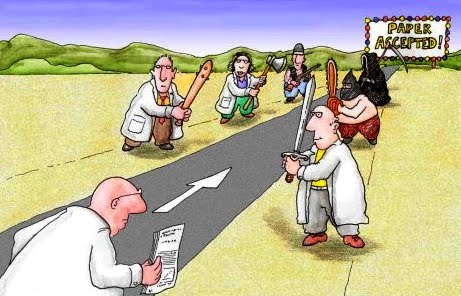
Google Images: Science publications

The publication process described above is pre-publication peer-review since the work is first peer-reviewed  (considered appropriate for publication) and then actually published (made public)

There is an alternate model of peer-review which is followed by arXiv.

So what is arXiv?

As stated by arXiv website:
arXiv.org (formerly xxx.lanl.gov) is a highly-automated electronic archive and distribution server for research articles. Covered areas include physics, mathematicscomputer sciencenonlinear sciencesquantitative biology and statistics.

So basically arXiv allows post publication peer review. You get a platform to publish your work while the pre-publication peer-review goes on and takes its own sweet time. Your work is read by peers and criticized and commented on.The greatest advantage of this model and arXiv of-course is not only that your work is quickly out in the public domain but also you start getting immediate feedback. ITS OPEN ACCESS.

arXiv is if I am not wrong a general rule in the fields of Physics and Mathematics. Biology is relatively new to this model of post publication peer-review.

In biology, the way post publication peer-review goes ahead is, the scientist receives feedback to his paper mostly via blogs wherein other scientist,PhD students, possibly anyone expresses their view either in support or against his finding! In real-time scientist can engage with the other scientists and discuss their work, which is frankly speaking a huge plus not only to the scientist but to the field.

Personally though I was aware of the existence of arXiv for a longtime only recently I got a chance to experience the post publication peer-review at work via axXiv.

So back in April 2012 this year there was this paper published in Nature(pre-publication peer review) titled
Evidence of non-random mutation rates suggests an evolutionary risk management strategy

Link to the abstract here.

This paper challenged the belief that mutations that occur in an organism's genome are random and essential genes in the genome have lower mutation rates.Indicating some sort of risk management which prevents organisms from the deleterious effects of mutations in essential genes.

A paper with such general belief challenging claims obviously got a lot of coverage by popular science press where scientists discussed the paper in details.

In September this year 2012 a paper challenging the above mentioned findings was published in arXiv, titled
Horizontal gene transfer may explain variation in θs

In this paper the authors find that there is no significant difference in the rate of mutations across different genes and hence mutations are random and not non-random as the previous paper claims.

Now in an non-awesome world these papers would have been published, read and may be discussed among small groups in the respective labs from where both these papers come and end of story!

Thanks to Haldane's Sieve which believes in increasing the exposure to interesting papers, published a blog on both these papers and one thing led to another and now we have the the lead authors of both the papers discussing their science and we know what reasons Inigo has to believe mutations are non-random and why Rohan thinks otherwise! Eavesdropping on the comment section of the above mentioned blog tells us a lot more about this study from the authors themselves, which is supercool! Check it out and you would know what I am talking about!!!

A win win situation for science!

P.S: An update posted by Inigo and Nick on Haldane's Sieve (5th Nov).

Wednesday, July 6, 2011

Why I love doing what I do?

If you follow me on twitter or you have spoken to me or just happen to be around you will know
How F***ed up I am currently with my experiments...I am in the phase..yeah PHASE where things just go wrong or don't work for some unknown reasons and all you have is a horrible day/week/month -PHASE in the lab!!!

The irony is...still I want to write or I am in the mood to write yes! about the

"Pleasures in doing Science(biology)"

photos clicked by vidhi patel

I have been blessed by some truly AWESOME ( here even awesome is an understatement) moments for which I LIVE and do SCIENCE.

I may never in my Life win a Noble, I won't! But surely more than once I Win through some moments that make me happy amidst the situations when things are difficult! 

These moments may neither be big events nor be to be bragged about success stories...they are simple and yet they put a huge SMILE on otherwise tensed face!

The moment when-
  • the tube inside the electroporator doesn't arc...
  • after n rounds of cloning et al the plate shows the clones/mutants the sight of that off-white small tiny-tiny colony! :)
  • the gel picture has bands of perfect size (so perfect that the reviewers might suspect it to be Photoshopped)
  • positive and negative controls are picture perfect! Specially the negative control!!!
  • at one go I hit the bulls eye... pick up the right number of tubes and weigh the right quantity!
  • I start with a new project and it looks all interesting and the euphoria of looking at new things is like the one when you are gifted with a new toy!
  • I read an amazing piece of literature...listen/read to a logical and well reasoned argument!
  • when I talk to a biggie in the field! You always want to meet and talk to the successful well established peers in your field! 
  • when after an Eureka moment things START MAKING SENSE
  • I am satisfied (though never) and happy as to what I am doing!(mind you very few people fall into this category)

and THE moment for which all of us...every researcher works hard,contemplates,procrastinates 
INVENTION/DISCOVERY/FINDING (peer reviewed :P)
Such moments just "work" they are part of enjoying your job and its just not me it seems it happens to best of us... like my friend working in Computational Biology says 'The kind of joy and satisfaction he gets once he is through a difficult to code Code is surreal'

While we pursue the Questions we ask we also 
Cherish the Moments that lead to it!

And This is part of sharing 'those' moments -

(via twitter)
    Nascent Biologist 
    Meetings always re-energize me - they remind me why being a scientist is so much fun!

      Alec Ross 
    20 years ago today, Tim Berners-Lee published his proposal for the World Wide Web. The proposal

    Saturday, November 20, 2010

    TRANCE...

    1.       I am on some beach with my family and few friends …we find a place to settle down and hog on some sandwiches that we packed for ourselves and head straight to the waves. Its day time but its not sunny as one might expect. But it’s just a perfect day as it happens to be in the month of July in Mumbai…all cloudy dark and rainy…a day when you feel hitting the Worli Sea face and getting hit by those marvellous but dangerous waves!Now amidst enjoying our splashes in the kind of violent sea suddenly with one wave we all get  smeared with sand what is popularly known as ‘reti’ the grayish black one. And I manage to kind of take it along with the water down my throat. So now its kind of chocking me, I am coughing hard, spitting at a very high frequency…in the middle of this may be when I am in the TRANCE  of sleep and being awake I open my eyes see myself lying on my bed and trying to spit! A part of hygiene conscious, neat and tidy me saying don’t spit you will spoil your bed!!! Other which is fortunately more practical (and understands life comes a zillion light years before being clean and all that) saying you are chocking you idiot spit, spIT, SPIT and… I open my eyes SPIT! Observe that it’s just few drops of saliva there wipe it off and sleep back!!! After I get up few hours later I feel eew for once and then feel thankful...my survival instincts are all at place and functional! :) 
    2.     I was at some pool in Mumbai it was an awesome huge pool I must say, swimming rounds after rounds enjoying all the swim activity TOTALLY. The pool was scarcely populated I mean may be 5-6 ppl in that huge pool so no one can possibly bump into each other. I get out of the pool and meet one of my acquaintances she is a doc now from JJ and suddenly there is some another lady there who starts interviewing her right there! She asks her a question it was some nice question I remember just that… to which my friend cant answer...at the same time even I am thinking of the answer but can’t get to it...I kind of give up! The lady who asked the question in the first place she herself answers it … can you beat that!!! And in the TRANCE as I call it … I am wondering DAMN IT its my BRAIN - my DREAM, my brain is formulating these questions that are coming through this lady and still I myself can’t answer it at one moment and at the very next moment MY very own brain answers it through that god damn lady!!! COMPLICATED phew!Later in the morning I tried real hard to remember that question but failed! But I must say it was a good question cause it gave me a nice feeling when it was asked and again when it was answered! :)
    3.      Now this was just outside Matunga central station I am alone I mean there are people around me like they would have been near the stn as always but I am not accompanied by any of my friends or colleagues or acquaintances. I am heading towards the stn and I see one man heading in opposite direction to which I am moving …we both cross each other and at the very moment I smell that he is heavily drunk and say to myself ‘bevada s****’ Now again in the trance I think how can I smell in my dreams and believe me I actually did smell in real, that moment!!! I mean seeing a thing clearly is kind of okay normal, but this was the first time I smelt in my dream! It was kind of eureka moment in my sleep and I slept again!My first encounter with smell in my dream! Don’t know why but I was kind of happy that morning! It was as if I had discovered re-discovered the sense of smell…! lol
    4.      Once I was on a visit to some school or college and there was this huge old building which had an auditorium hosting some function. Don’t remember what was the assembly all about but I was there to attend.  The auditorium was filled with students - girls and boys at least 500 (rounded off to lowest fig. definitely much more) all were seated occupying the benches /chair whatever. I was moving back towards the end rows in search of a seat. Trust me I could actually see faces of all the students I passed none of them I knew or have had seen before or even later in my life! Again in the TRANCE I think how my mind can make up these distinct,entire human faces all at once! I am over burdening it of generating too much of data… move out, move out of the auditorium...NOW  and I moved out and my dream continued outside the Audi!

    I  wonder in awe about the marvellous thing that evolved and happened to all of us called BRAIN!!!


    P.S : Article in SciAm on 'seeing' in the dreams! 

    Thursday, November 4, 2010

    What are you working on?


    A question that comes to me *too* often these days after the initial greetings and what are you upto these days inquiries!

    I truly appreciate the curiosity and I like it when someone is interested in knowing what kind of work do I do?
    BUT the point is the people asking this very *interesting* questions are in our common usage terms *layman*


    Just to give an example,
    If I am working in the depths of Mariana trench, they are at the shore/the beach! And now, how will one at the shore in *unscientific (read sane/layman)* terms understand and if by a very gross mistake understand; appreciate the need, fun and challenge in doing something AWESOME called *RESEARCH* which in the general perception is a boring, insane activity restricted to the nerdy, whimsical minority!


    I mean when I was working for my dissertation,
    I at least had *circuits* handy- to which if I attach genetic its okay! Cause out of *genetic circuits* people definitely have heard of circuits (I don’t expect them to know what it is, the meaning part, except for those with science background) but it’s okay I mean! SAVER
    And then comes *protein* (in my mind- sorry no substitute available here, might give milk protein caesin as an example but no SUBSTITUTE) and then this *protein* (still the person figuring out what I just said) is never produced in constant amount (Why? I don’t allow them to ask or this question never comes to the person’s mind, don’t know! BUT THANK GOD) so, we have designed a circuit which will produce the protein in constant amounts! Tadaa!!!


    And there is SILENCE Golden SILENCE until one of us comes up with a CHANGE of Topic!!!


    BTW now I work on expression of stress, cell division and repair related genes in E.coli, which has been evolved for 2000 generations in the lab under Oligophilic low nutrient conditions!
    I better not talk about this one!!! STRESS (in cell?) REPAIR (what to repair, in a cell?) and EVOLUTION!!! (BTW almost everyone knows or has heard of Darwin J )


    (I wish to appear SANE to the layman’s world, I am no different! I am your kin, your species! )


    I think every RESEARCHER/someone doing SCIENCE must have gone through such a dilemma where you are so eager to talk about your work; but even after trying hard, harder and still Hard(btw if you do this you are boring) you are not satisfied with your own explanation and convinced that the other person *layman* has not understood it! I go through this definitely!
    Nonetheless, howsoever boring I might sound while I talk about my work to you (which is in the *true* sense, is not boring, you fail to appreciate it due to: still figuring out what?)

    I LOVE DOING IT
    IT’S AWESOME
    NOTHING ELSE MATTERS!!!
                
    P.S: All special characters are intended!

    Wednesday, May 19, 2010

    On a lighter note...

    Location: Pune

    Date: 13/05/10

    Its 2:16 on clock...it's hot! And adding to it are the mosquitoes sucking a few millilitres of my blood...the blood suckers!

    Why don't they jus shoe off...I am bugged, truly!

    I wish my blood was poisonous...no no not to me but to these mosquitoes...I wish...aargh got another bite...Losers!

    A quick thought chain...People with sickle cell anaemia don't get malaria, are they unbitten by the mosquitoes too? (By at least the mosquitoes carrying malarial parasite)

    Reframing it, have mosquitoes developed a strategy...putting it in the right words "evolved" a stratergy wherein atleast for the time being the malarial parasite bearing mosquitoes can avoid sickle celled individuals in whom the parasites future just doesn’t exist??? But then in that case the host mosquitoes are loosing on their hosts (humans)...and that too for a hitchhiker!!!

    Can be, may be ...its jus a speculation...can happen too...parasites are drivers of evolution in many scenarios...so you never know…if the logical reasoning goes fine for once…we can at least expect it to happen! Pretty unsure…

    For now let us assume that the above mentioned phenomenon of avoiding sickle celled anaemic occurs…it will have to be tested!

    And the way of testing the above, makes a hilarious sound! (Unfortunately this comes from a person with average or rather below average sense of humour…so be prepared if it turns out to be lame)

    Nonetheless this is how it goes…

    Advertisement for volunteers for the “Mosquito Bite Project”

    Volunteers required for- being bitten by female anopheles mosquitoes carrying, if your unlucky falciparum and if your super unlucky vivax and if you are super duper unlucky both"

    Don't Panic - you will also be bitten by mosquitoes with absence of malarial parasite! It's not all that bad you see.

    You can just be a lucky volunteer too...How? Be a negative control volunteer

    Or a second chance to be super unlucky - Be a positive control volunteer

    All you have to do is stand in a chamber and you will be attacked with n number of mosquitoes for time m (m needs to be calc and for determining n it is necessary to consult a statistician cause the experimenter just doesn't want to “harassthe volunteers with too many mosquitoes; neither wants to repeat the experiment just because the mosquitoes were too less)

    * Volunteers with sickle cell anaemia a plus point for you; you will only get bitten by mosquito and no malaria or might not even get bitten in the first place (hoping for the later to happen)! So hurry up! Offer not valid for non-sickle cell anemics for this season. If the above works out... you might be considered for season 2! So keep checking the site for updates.

    So hurry up, be the first one to send your consent.

    Send in your consent with the answer to the following question:

    Why you want to be a part of this "Mosquito bite" project?

    a) You care for the Mosquitoes

    b) You want to contribute to the cutting edge research on Malaria

    c) You have nothing more challenging and exciting to do

    d) You have also experienced Mosquito bite n number of times in your life and now want to end it once and for all! And this research according to you is a step in that direction!


    2.44 On clock...me still being attacked by mosquitoes!

    Wednesday, December 30, 2009

    Post "3 idiots"

    Okay...I watched 3 idiots and its just awesome! I want to watch it again and again...

    It's first of a kind movie I should say which is at par with the book...that it is based on "Five point someone" by Chetan Bhagat.

    The core idea that the movie puts forward is to be knowledge sucker and not marks sucker!
    And not to mention when Amir delivered the dailogue " saying if you seek knowledge, success will be automatically there, in fact success will run behind you" reminded me of Phadke sir (my HOD at Ruia) saying "exams are just a side effect, they just come and go- we should have a lecture even a day before the exam" So very true...I always feel!

    Also, I think the movie has glamorized or rather brought into limelight...the geek, the nerd, the out of the box thinker...in every class! And this ability to ask questions and thinking unconventionally is there not in just a few from the class but in fact every born soul on this planet...but our education system is far too much against questioning and is to all the extents marks oriented!

    No wonder Americans and Europeans of Indian origin win noble prizes in Science...cause education system here,doesn't allow you to think of nothing except marks and peer allows you to think of just a good college-an awesome placement-an excellent package-a decent spouse-children and thats it...thats life!

    Friday, September 18, 2009

    Leucoderma-HW

    There was this study done on a population having Leucoderma in Gujarat and it was found that the alleles involved were in Hardy-Weinberg equilibrium...! The results were surprising because we expect selection to act against the individuals with Leucoderma...because of the so called "mate choices" . But this wasn't the case here... again a study followed to determine the reason for absence of selection! It was found that the symptoms of leucoderma i.e the white patches on the skin occurred or were visible only after the subjects got married... they were totally absent when the mate choices were made...thus selection did not occur against the trait.
    (My second encounter with the Hardy-Weinberg law...was with this example and since then whenever i see a person with Leucoderma Hardy-Weinberg law marquee makes an appearance!)
    These days more often... I not only encounter quite a few people with Lecuoderma but also these people are quite young! (this is in mumbai) Making my mind wonder of the allele stats...I think the current scenario points towards, selection pressure acting on these alleles cause the symptoms are evident before the mate choice...so selection pressure must definately act, ideally should act and in the future should lead to gradual dilution of this allele from the population.
    It's only for someone to study the population of those affected with leucoderma and highlight the allele stats!
    Looking from point of view of a science student: Day to day, current, classical example of Hardy-Weinberg law and selection pressure at work.

    Thursday, July 2, 2009

    Personified...

    They were worried about their constant numbers for days together...And today the fate of few of them was going to change...few of them there, were about to be picked up, the future was dark, totally unaware of their destiny! The time came...and they were scraped off in lakhs...! What came next was totally unexpected, they got suspended in a liquid, that liquid was LB!!! Draining off all the worries...
    (Seated infront of the Laminar Air Flow armed with a loop, I was doing my usuals of inoculating coli colony in a medium flask...was when I got into the coli's shoes!)
    How does it feel like? I questioned and the answer that clicked was "a big fat feast" Oh..really? Naah...! It was something definately beyond feast...I mean feast is "so short term" (sounding "so middle class" types-sarabhai style)It's like I don't know what...but come to think of its a full proof gurantee of survival of your next 30 generations(sounding highly exagerrating)! whoa...!And we as humans here, are not even sure of our own survival, forget about our next generations!

    Saturday, February 28, 2009

    Synthetic Biology: Engineer’s Approach to Biology

    Abstract-

    Contemporary biology recognizes the genes and proteins responsible for a particular cellular phenomenon, but today at this hour the focus is on deciphering the connectivity between those genes and proteins. Mathematical models best describes these circuits, which in reality resemble the electric circuits. In this scenario, biology is looked at through engineer’s perspective, providing the framework for the construction and analysis of the underlying sub modules that constitute the network. Thus synthetic biology creates a platform on which prediction and evaluation of dynamics of cellular processes is facilitated. In this review we will take a look at synthetic biology and the varied facets it offers.

    Keywords: Synthetic biology, oscillator, reprissilator, cellular noise, biobricks.


    “…the clock ticks life away…” teens hum on the tunes of Linkin park. (Popular band)
    Though the lyrics refer to the passing time in context of digital clock or watch…the man created version. The same words hold true for the nature’s version of the clock…the biological clock as we may call it.
    In order to understand how exactly the clock ticks or works…one may have to break open a clock and look at its components…best way to get a better insight into its working, is to try creating one’s own clock out of similar parts!
    The previous is what contemporary biology deals with, using genetic and biochemical techniques to isolate genes and proteins involved in feedback loops of gene expression, that are necessary for clock functioning of biological clocks e.g. circadian rhythms.( Cyran, S. A. et al., 2003)
    But the later, is the one which helps us answer insightful questions pertaining to the clock like-

    1. What sets the period of the oscillation?

    2. How does the clock operate reliably in diverse cellular conditions? and

    3. What features of its design are responsible for its reliable operation?

    The above mentioned i.e. creating a new clock; is the way Synthetic Biology approaches the biological dead ends! Several synthetic genetic clocks have now been constructed in bacteria and mammalian cell lines too.( Fung, E. et al, 2005; Tigges Marcel et al, 2009) These circuits are simpler versions of the actual naturally found biological clocks.


    What exactly is synthetic biology?

    Marc W. Kirschner (Department of Systems Biology Harvard Medical School) sheds light on it…

    “Synthetic biology is the study of the behaviour of complex biological organization and processes in terms of the molecular constituents. It is built on molecular biology in its special concern for information transfer, on physiology for its special concern with adaptive states of the cell and organism, on developmental biology for the importance of defining a succession of physiological states in that process, and on evolutionary biology and ecology for the appreciation that all aspects of the organism are products of selection, a selection we rarely understand on a molecular level. Systems biology attempts all of this through quantitative measurement, modeling, reconstruction, and theory. Systems biology is not a branch of physics but differs from physics in that the primary task is to understand how biology generates variation. No such imperative to create variation exists in the physical world. It is a new principle that Darwin understood and upon which all of life hinges. That sounds different enough for me to justify a new field and a new name”


    Synthetic biology deals with ‘programming’ of the cell. Reprogramming a cell involves the creation of synthetic biological components by adding, removing, or changing genes and proteins. Design, fabrication, integration, and testing of new
    Cellular hardware lies at the core of this field. But the tools and methods necessary for same are derived from experimental biology. The process begins with the abstract design of devices, modules, or organisms, and is often guided by mathematical models. The synthetic biologist then tests the newly constructed systems experimentally. However, such initial attempts rarely yield fully functional implementations because of incomplete biological information. Rational redesign
    Based on mathematical models comes for rescue in such situations.

    Newer approaches to address and deal with synthetic constructs are also being developed-

    1. One can just apply directed evolution to genes comprising a simple genetic circuit and what you get is evolution of improperly matched non-functional components to functional ones.( Yokobayashi Yohei et al, 2002)

    2. In silico evolutionary procedure is also being used to create gene networks performing basic tasks. Main highlights of this procedure are that small functional modules with diverse functions can be created.( Franc¸ois Paul et al, 2004)

    3. Yet another approach could be just to couple simple models into complex networks with behaviour that can be predicted from individual components. Thus properties of regulatory sub-systems can be used to predict behaviour of larger more complex regulatory networks.( Guido Nicholas et al, 2006)

    Designing constructs…

    Modeling and construction of many and varied gene regulatory circuits are reported till date. Oscillators being the most popular, are constructed by coupling positive and negative feedback loops, such that the whole system oscillates or moves back and forth between the two steady states. Also lots of variations are also possible here, in terms of the components that make the whole system oscillate.

     In case of E.coli itself it is possible to construct oscillatory circuit using IPTG, lacI protein and arabinose regulatory sites, together.( Stricker Jesse et al, 2008; M Rachael et al, 2002) Similar is the deal with reprissilator in which three transcriptional repressor systems build an oscillator, but the twist is that the period of oscillation is shorter than cell-division cycle, so the state of oscillator needs to be transmitted to the next generations. Thus such reprissilator make possible, design and construction of artificial genetic networks with new functional properties from generic components that naturally occur in other contexts.( Elowitz et al, 2000)
     In the same E.coli one can also create oscillations by exploiting glycolytic flux i.e. construction of a metabolator! In this acetyl phosphate acts as a signalling metabolite and under its control the two metabolite pools interconvert.( Fung, E. et al, 2005)

     Toggle switches are another kind of circuits tried and tested in E.coli which require only transient induction and hence can function as a cellular memory unit. This can very well be exploited in industries, since it permits high induction of recombinant proteins without the high cost of large quantities of inducer. (Gardner Timothy et al, 2000)

     Establishment of communication between bacteria by constructing an artificial quorum sensor has not only enabled intraspecies but also intrespecies communication possible, leading to various behaviours and phenotypes. It facilitates achievement of co-operative transcriptional response.(Garcia-Ojalvo Jordi et al, 2004; Bulter Thomas et al, 2004)

     Mammalian cells are also being used for construction of oscillators which give self-sustained, tunable autonomous and robust oscillations, thus opening new vistas for future gene and cell therapies.( Tigges Marcel et al, 2009)


    The untold story…

    Synthetic biology is not just messing around with the genome (as it may seem to be from the above text) to make useful constructs, basically its not tinkerer’s approach but engineers approach to a problem.

    One can say that success of synthetic biology is essential to understand life…this is because in this whole process of modelling, construction and testing the understanding of the system itself is achieved in a better way. This holds true not only for the insight into working of the cell cycle (a mitotic oscillator is at work there) (Goldbeter Albert, 1991) but also in understanding of the sleep-wake cycle or the circadian rhythms.

    It is only while working with the synthetic constructs a phenomenon of “noise” comes into light. Noise is the one which can actually collapse your circuit or rather may give your circuit an insignificant and non-functional look! Trying to reduce the noise level in one’s own construct(Orrell David et al, 2004) leads to design enhancement and also appreciation of the noise resistant constructs found in the nature built circuits!( Vilar, J. M et al, 2002)

    Fascinating shades…

    A giant leap of synthetic biology is to “write the genome” as Craig Venter puts it! As a step in this direction not only have they constructed synthetic whole genomes(Smith Hamilton et al, 2003) but also expanded the genetic code with a functional quadruplet codon.(Which can incorporate unnatural amino acids into proteins.)(Anderson Christopher et al, 2004)

    In order to bring all these constructs and related research in laboratories around the world under a common umbrella standard protocols and registry of the constructed parts has been developed on the World Wide Web http://partsregistry.org/Main_Page. It actually involves efforts to develop “tool box” of standardized genetic parts with known performance characteristics—analogous to the transistors, capacitors, and resistors used in electronic circuits—from which bioengineers can build functional Devices and, someday, synthetic micro organisms. The registry is made up of components called “BioBricks,” short pieces of DNA that constitute or encode functional genetic elements. Examples of BioBricks are a “promoter” sequence that initiates the transcription of DNA into messenger RNA, a “terminator” sequence that halts RNA transcription, a “repressor” gene that encodes a protein that blocks the transcription of another gene, a ribosome-binding site that initiates protein synthesis, and a “reporter” gene that encodes a fluorescent protein. A BioBrick must have a genetic structure that enables it to send and receive standard biochemical signals and to be cut and pasted into a linear sequence of other BioBricks. Further, work on the lines of improvising the repository of biobricks and methods for their easier handling is being done, actively.( Peccoud Jean et al, 2008; Shetty Reshma et al, 2008) Also work on the lines of developing an organism with minimum essential genes(Glass John et al, 2005), so that the organism can be exploited efficiently for integrating the constructs, is in progress.

    Excellent examples of intelligent use of the toolbox involves -

    1. Engineering a metabolic pathway for the synthesis of artemisinic acid in yeast, which is the immediate precursor of the drug artemisinin( a natural product) that is highly effective in treating malaria, thus reducing the cost of the drug.( Ro Dae-Kyun et al, 2006)

    2. Construction of a sensory synthetic kinase that allows a lawn of bacteria to function as a biological film, such that the projection of a pattern of light on to the bacteria produces a high-definition (about 100 megapixels per square inch), two-dimensional chemical image. Thus using spatial control of bacterial gene expression to 'print' complex biological materials, for example, to investigate signalling pathways through precise spatial and temporal control of their phosphorylation steps.( Levskaya Anselm et al, 2005)


    It is crystal clear that the field of synthetic biology has the potential to bring about epochal changes in science and a few decades from now it may have a profound influence on the definition of life, itself!

    Perhaps the most intriguing problem right now is to observe how the designed circuit operates in the context of a complete organism. There are no dotted lines inside the cell isolating circuits from one another. The ultimate test for this synthetic approach is to delete natural circuits and replace them with synthetic counterparts within organisms. This will lead to interference of the synthetic circuits with the rest of the cell. Obviously these circuits would be less functional than their natural counterparts. But at this stage one can learn more by putting together a simple, though inaccurate, pendulum Clock, than one can by disassembling the finest Swiss timepiece.

    (these days i am going gaga... over synthetic biology...so after my paper ppt my review follows...again on synthetic biology! nothing like it if get to work in relation to the field...hopefully!)

    Wednesday, February 18, 2009

    Abstract to paper ppt...scheduled 21st feb

    yet another sem and yet another paper ppt....though my preparations ...hardly any preps...i m in love with synthetic bio these days...so here it is...abstract to my paper...no sorry abstract to the paper i selected...


    A Tunable Synthetic Mammalian Oscillator

    Marcel Tigges, Tatiana T. Marquez-Lago, Jo¨rg Stelling & Martin Fussenegger

    Nature, Vol. 457,309-312 (15 January 2009)


    Abstract

    Oscillator circuits mediating the periodic induction of specific target genes are time-keeping devices found in circadian clocks. Here, is described the first controllable mammalian oscillator, constructed based on an auto-regulated sense–antisense transcription control circuit. The circuit encodes a positive and a time delayed negative feedback loop, enabling autonomous, self sustained and tunable oscillatory gene expression. The designed system was monitored using oscillating concentrations of green fluorescent protein with tunable frequency and amplitude, by time-lapse microscopy in real time in individual Chinese hamster ovary cells. This synthetic mammalian clock may provide insight into dynamics of natural periodic processes and also enable complex gene therapy treatments by automating physiological processes in future gene and cell therapies.

    References-


    1. Jesse Stricker, Scott Cookson (2008) A fast, robust and tunable synthetic gene oscillator. Nature, Vol. 456, 516-520

    2. Crosthwaite, S. K. (2004) Circadian clocks and natural antisense RNA. FEBS Lett. 567, 49–54

    3. Gossen, M. & Bujard, H. (1992) Tight control of gene expression in mammalian cells by tetracycline-responsive promoters. Proc. Natl Acad. Sci. USA 89, 5547–5551

    Thursday, December 4, 2008

    Simple questions, are they???

    Here are some very simple….brain storming questions…??

    • Everyone of us have traveled in a bus…and most of us prefer to have a window seat…at least I do…!
    So when at the window and the windows full open and air rushing inside and is continuously being bombarded on face….an amazing feeling leaves…. a simple question…all that air that is coming inside the bus from all the windows, from where does it move out??? It must be going out…from somewhere???…its not that its just coming in…right??? So from where exactly does all this air move out????

    • Somewhere in those childhood days…used to cycle day-in and day-out…those early days of learning to ride a bi-cycle were full of fear of a fall and bruises on all possible places on the body…I even managed to land up in a gutter once (thankfully it was dry…!) So…what now I can ride bicycle quiet well…but am unable to answer a simple…real simple question…at least it looks simple…why does a bicycle or take just one Tyre of bicycle can balance itself well when in motion….but not in absence of motion??? One would realize that if you go on balancing forces(in order to justify the phenomenon) that are acting on the moving Tyre…same are applicable for a vertically placed motionless Tyre…but still it falls off…!


    (Questions …discussed at Tuesday’s group discussion sessions!!!)

    Saturday, October 25, 2008

    Bio-diversity...

    today(23rd Oct 2008) was a knowledgeable day...it changed the way i looked at many things!!!

    The topic was Biodiversity and the venue was NCL (auditorium) Pune.
    The day was as pleasant as it could be...the air refreshing and the ambiance enthusiastic...greeted with excellent photographic lobby of birds,snails and flowers...they really couldn't have appeared better than these! The auditorium was filled with students, teachers, research fellows and eminent scientists belonging to varied fields...it was the very first encounter with diversity for the day!!!

    “you look at that river gently flowing by. You notice the leaves rustling with the wind. You hear the birds’ you hear the tree frogs. In the distance you hear a cow. You feel the grass. The mud gives a little bit on the river bank. It is quiet; it’s peaceful. And all of a sudden, it’s a gear shift inside you. And it’s like taking a deep breath and going….. Oh’ yeah, I forgot about this” (An inconvenient Truth)

    The first talk was by Dr. H.N.Gour...he gave an full-fledged introduction to bio-diversity...also impressed the Puneites...with introductory Marathi lines! A very important point that he put across was of GMO's and issues related to them, also truly quoted biodiversity as GLOBAL WEALTH.

    The next to come was the best of all I feel...Dr. Hema Sane, she grabbed the attention of every pair of eyes...right from the moment her name was announced and she was on the podium...a real simple down to earth lady she is...in her late 60's may be! A botanist, had focused her lecture on "Wild is Beautiful" part of plant diversity!
    Doing justice to the title...she actually showed the true beauty of the wild, excellent pictorial representations and her precise perfect descriptions...completely changed the way i looked at botany as a subject and plants in specific! During her talk she conveyed a very important message...Conserve plants and other life forms not for humanly benefits...but for them..The plants themselves... because you are no one to decide their fate but you need to respect their rights!!!

    Aditi Pant took us to Antarctica, she really did!!! With million dollar pics of the Antarctic biodiversity...she explained the food webs there and gave a precept of microbial, fungal, algal, plant, animal and aquatic biodiversity at the Antarctic!
    Her good sense of humour was evident during the talk and she convincingly showed "humans are the real problematic creatures on this planet"

    Dr.M.V.Deshpande enlightened about the fungal-insect interactions which i never even thought of...the various aspects and the questions posed by him were actually challenging. The journey from pathogenecity to non-lethal parasitism was truly commendable!

    Next in line was the topic most hyped these days in microbiology "the unculturables" basically it was “Molecular Approaches for Exploring Uncultured Bacterial Diversity in Extreme Environment” It was an excellent comparison of various techniques used in molecular methods and the boon they are in studying bacterial diversity without culturing!!!(Wow!)

    Have you ever thought cockroaches were beautiful...or rather can ever look beautiful? And they show parental care? And insects were the most dominant life forms? This was exactly what Dr. Hemant Ghate shed light on...! He really changed the way we all looked at those creepy creatures!

    This was the most impressive man; btw most impressive was his CV...A radiologist by profession and also an ornithologist and photographer!!! Dr.Satish Pande
    He had got all his statistics right, right from avian food preferences to their nesting periods to their clutch size to their cultural significance from conservation angle(phew!)
    Best were his recommendations for conservation of avian diversity!

    Dr. Sawarkar had a collection of excellent quotes...he gave an overall picture of Indian biodiversity and statistics of the endangered one’s and also a word of caution about the wrongly put forward exaggerated figures of the actually non existing wildlife!

    All in all the workshop was truly an eye opener..it made quite a few things evident...


    1. mimicking is a very successful strategy employed by diverse life forms!
    2. presence of mind is the most important facet of life everyone should adorn(all speakers had excellent presence of mind and related their talks to fellow speakers quite well)

    Something to think on...
    “Darwin gave us the first glimpse of the origin of species. We know now what was unknown to all the preceding caravan of generations: that men are only fellow voyagers with other creatures in the odyssey of evolution. The new knowledge should have given us, by this time, a kinship with other fellow creatures; a wish to live and let live; a sense of wonder over the magnitude and duration of the biotic enterprise” -----Aldo Leopold

    Thursday, October 9, 2008

    Noble prize 06-07-08

    Still remember the day quite well…though not the exact date…it was back in the first week of October 2006. I was doing my fav job of the day…reading TOI…and on the Trends page I came across an article on RNAi…mentioning the phenomenon, which fetched A. Fire and C. Mello, a noble in medicine that year. The phenomenon was mentioned quite in brief in layman’s tongue…! After reading the article my curiosity was at its peak and I went ahead reading voraciously about it…how fascinated and amazed I was then!!!
    From that particular year I started waiting for the noble prize announcements quite eagerly…!
    Had heard about the noble prize for the first time I don’t even remember when…it is quite early in your childhood that you come across the noble prize thing…
    But the same curiosity the same fascination and the same amazement did not continue to happen for the following years i.e 2007 and 2008(last yr and this year resp.)
    If I am not wrong the noble prize in medicine for the year 2007 was given to the founders of gene knockdown technology…wherein you can knockoff a particular gene and look at its function…!
    No doubt it was a great discovery that had revolutionized way research took place in terms of deciphering gene function!!!
    But then what disturbed me most was that the discovery was quite old…I mean in today’s context this p’cular tool has been exploited for quite some years now…! I mean its quite surprising that RNAi which provided one of the methods for gene knockdown, which was new…fetched noble prize even before gene knockdown thing itself…!
    Even this year when the noble prize in medicine and chemistry were declared…the same thought struck…
    Noble prize in medicine went for the discovery of HIV replication cycle and
    Noble prize in chemistry went for discovery and use of GFP
    Both again were great discoveries…but then both of them are well exploited and established for years now!!!
    What I intend to convey here is that …the noble prize that are announced every year should go in for recent discoveries…this in no way means that the discovery made in the past decades were not significant…but then I think there shouldn't be a lag between a great discovery and its corresponding noble…!
    I think that level of foresight…should definitely be there which recognizes the implications of significant discoveries and its effect in a short term…!
    According to me 15-20 years of time…its pretty long for recognizing a noble!!!

    Wednesday, October 8, 2008

    An intresting evolutionary finding...

    Completely forgot, the existence of the following pile of words...
    i stumbled upon this while going through my desktop folder...
    reviving an older creation...

    Evolving Evolution…


    Evolution the magic word
    To me it first sounded absurd…

    Apes, Neanderthal and Sapiens
    By heart I learned…
    Cranial capacity, physiology and backbone
    This was the evolution I was made to know!!

    Thank god Darwin did not face this
    Otherwise he would not have proposed the natural selection thesis!!!

    Evolution I know is a brainy business
    But works according to one’s interest!

    Darwin and Lamarck with their theories start
    And you think both are equally right on their part!!!
    (though darwin most of the times and the later rarely)

    Many questions keep hovering around
    Archea, bacteria, virus, eukaryotic cell
    Tell me which one has evolved well???

    Understanding, learning, imbibing it
    Evolution for me is evolving bit by bit…

    Evolution can sometimes be confusing…
    One might seem to understand what he’s actually not understanding!!!
    To understand the point I mention
    Try answering this question

    Is perfection evolution’s intention???
    OR
    Is evolution unintentional perfection???

    Monday, September 1, 2008

    my first paper ppt...

    had my life's first paper presentation...!!!
    have given many ppt before this...but this one was really special one... was waiting for this since my B.Sc years...and really wanted this to happen in my M.Sc....and here it was on 30th Aug 2008...

    i have already posted the abstract here...and if anybody interested in reading the paper its freely available online(just type the title on Google...!!!)
    OK this paper was on evolution....and it is "the" thing for me.... so the excitement of presenting it was, i seriously cant explain at what levels...!!!
    actually looking at the paper...i was cautioned to take a simpler one...this one being interdisciplinary and this being my very first paper ppt!
    but was quite adamant on this particular paper...after all it was on evolution and RNA!!!(ribozyme)

    btw all the things required for the seminar i.e the abstract and the actual ppt... as usual did it at the 11th hr....mind well not at the 11.59th....
    for a change wasn't tensed at all about the whole thing...was the first one in the whole batch of the first yr M.Sc students to present...
    And let me tell you the whole thing went really well....i mean right from the intro....till the concluding line...it was just too good...at least i was satisfied...after the ppt!!!
    Still the most dreaded part of the seminar was left...the viva questions and let me tell you there were real intelligent questions asked by both the teachers in the panel and also by my seniors!!! real good questions...and i was most delighted after answering all of them....convincingly!!!
    i mean i presented for 20mins and was there at least for another 10-15mins answering the audience...it was fun!!!

    hmm...was really happy about the whole thing...it went so well...really wasn't expecting it to be this way...really cool...a wonderful experience....a lifetime experience i would say!!!
    now eagerly waiting for my next paper ppt...in the next sem...that time there will be many expectations too....!

    Tuesday, August 26, 2008

    abstract to my seminar ppt...

    Darwinian Evolution on a Chip

    Brian M. Paegal, Gerald F. Joyce

    PLoS Biol 6(4):e85. doi:10.1371/journal.pbio.0060085-

    Abstract

    Darwinian evolution in nature has led to development of many sophisticated enzymes. Recapitulation of Darwinian evolution in vitro has emerged as chemical tool for optimizing functional ribozymes in the lab. A ribozyme that catalyzes template-directed ligation of oligonucleotide substrate was made to evolve continuously under the selective pressure of reducing substrate concentration. A micro-chip based automated serial dilution circuit was developed which carried out serial 10-fold dilution after exponential growth phase, this was repeated for 500 log-growth iterations. Evolution of the ribozyme was observed during the 70h evolution process on the chip. The ribozymes adapted and achieved progressively faster growth rates over time. The final evolved ribozyme contained 11 mutations which conferred 90-fold improvement in substrate utilization, coinciding with the applied selective pressure. The constellation of mutations that aroused during this evolution process and the corresponding phenotypic changes that were responsible for the adaptation were analyzed. The system thus, aids in accelerating evolution and also allows the experimenter to observe and manipulate adaptation.

    References-

    1. Joyce GF (2004) Directed evolution of nucleic acid enzymes. Ann. Rev. Biochem.73:791-836

    1. Bartel D. P., Szostak J. W. (1993) Isolation of new ribozymes from a large pool of random sequences, Science 261: 1411-1418

    1. Cadwell R. C., Joyce G. F. (1992) Randomization of genes by PCR mutagenesis. PCR Methods Applications 2: 28-33

    Sunday, August 17, 2008

    http://www.allaboutthejourney.org/theory-of-evolution.htm

    a good read...(continue for the next pages...)

    gaia hypothesis

    http://en.wikipedia.org/wiki/Gaia_hypothesis

    sounds weird....
    guess...got the fact-reason relationship all wrong..very difficult to digest!